
Where Fintech Companies Break

Updated: Jun 5
What is the biggest risk when a fintech enters a new market? Earning local trust. And in financial services, that trust is built or lost on precision.

Most fintech companies entering new markets treat compliance as a legal workstream and language as a separate, later-stage task. The legal team handles the regulatory submission. The marketing team handles the translation. The product team handles the onboarding flow.
Then the licence application stalls. The onboarding flow loses users. The product that performed brilliantly at home finds no traction abroad.
Fintech does not break on ambition or product quality. It breaks on precision. In financial services, precision is a regulatory and commercial standard, not only a linguistic one.
Compliance Is a Language Problem
Regulatory submissions in fintech are precision instruments, and the standards they are held to vary significantly by jurisdiction.
A MiCA application in the EU, an FCA authorisation in the UK, or a SAMA licence in Saudi Arabia each carry specific disclosure obligations, defined terminology, and legal conventions that must be met in the local language. A submission that is linguistically correct but terminologically inconsistent with local regulatory convention creates friction and risks unexpected delays or rejections. Either outcome adds months to a licensing timeline that may already run to 18 months in complex jurisdictions.

The cost of getting this wrong is concrete. In the EU, MiCA-related breaches can trigger fines running into the millions. GDPR violations carry penalties of up to €20 million or 4% of annual global turnover. Operating without proper authorisation can result in forced market exit and reputational damage that follows a company into every subsequent licensing process. The language of your compliance documentation is part of the application itself.
Disclosure Language Shapes Buyer Behaviour
Beyond regulatory submissions, customer-facing disclosure has direct commercial consequences that most fintech companies underestimate.
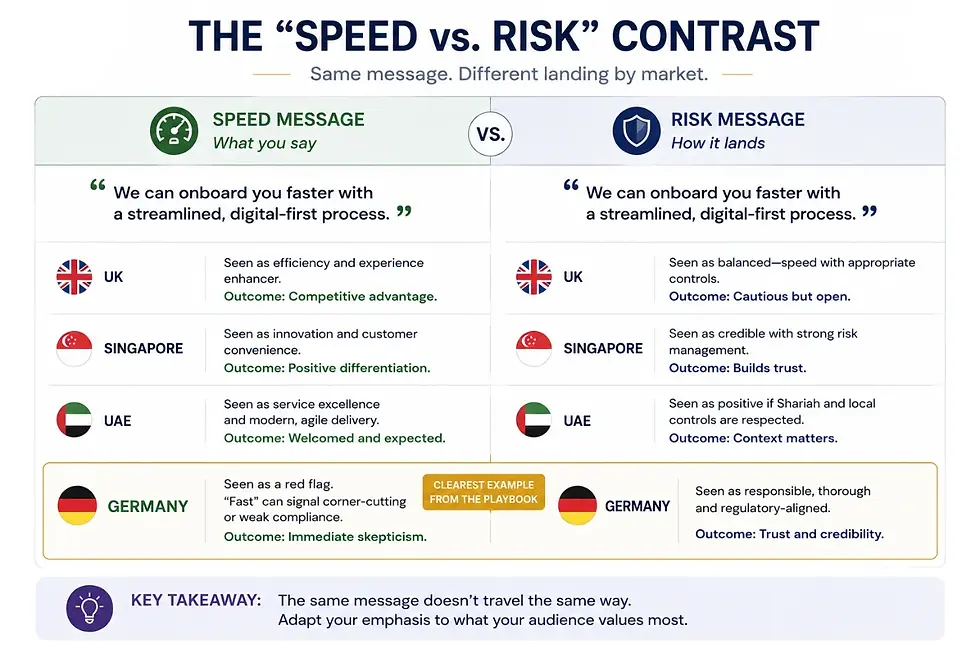
Consider what Biraj explored in the opening of this series: a fintech selling "Speed" in the US may find that the same message signals "Risk" in Germany. Translating that message accurately delivers the wrong positioning perfectly. Disclosure language creates a sharper version of the same problem. Terms and conditions, fee schedules, data consent frameworks, and risk disclosures are the documents your prospective customers read before deciding whether to trust you with their money. They carry legal weight, but they also carry commercial weight.
In markets with high financial literacy and regulatory awareness, customers read these documents carefully. In Germany, Scandinavia, and the Netherlands, ambiguous disclosure language reads as a trust signal, and not a favourable one. The clarity and precision of your disclosure language is part of your value proposition, whether you have designed it that way or not.
Onboarding Friction Is Where Growth Stalls
A fintech can navigate regulatory approval, build a compliant product, and still lose customers at the moment it matters most: the point where a prospect becomes a customer.
KYC and AML processes are a requirement in virtually every regulated market, but the friction they create varies enormously depending on how they are localised. An onboarding flow designed for one market's document standards, identity verification conventions, and data consent expectations will create confusion and abandonment in another. Users who cannot complete verification in their own language, using familiar document types and processes, do not complain. They leave.

Fenergo's 2025 global survey of 600 senior decision-makers found that 70% of financial institutions lost clients due to inefficient onboarding, up from 48% in 2023. Those users did not change their minds about the product. The process pushed them out.
Localised onboarding flows, with locally relevant verification steps and support in the customer's language, consistently outperform translated versions of home-market flows. The difference runs deeper than presentation. Onboarding is where acquired users become active customers, and friction at that moment compounds across every subsequent growth metric.
Precision as Competitive Advantage
The fintech companies that expand successfully internationally treat language precision as a strategic input from the start. They engage localisation expertise when regulatory submissions are being drafted, not after. They localise disclosure language for cultural resonance, not only linguistic accuracy. They build onboarding flows for target markets rather than translating existing ones.
Getting it right builds the trust that financial services growth depends on. The penalties are simply the cost of getting it wrong.
What Comes Next
In the next edition of this series, we look at how digital marketing teams break on intent, where translated keywords fail to capture real demand, and what to do instead.
Is your fintech expansion built on precise, locally compliant foundations? Start with an International Digital Audit.
👉 Start with an International Digital Audit
Not sure whether your regulatory and operational readiness matches your growth ambitions? Download the International Expansion Readiness Checklist.
👉 Download


Comments