

Turn Your Website into a
Global Growth Engine
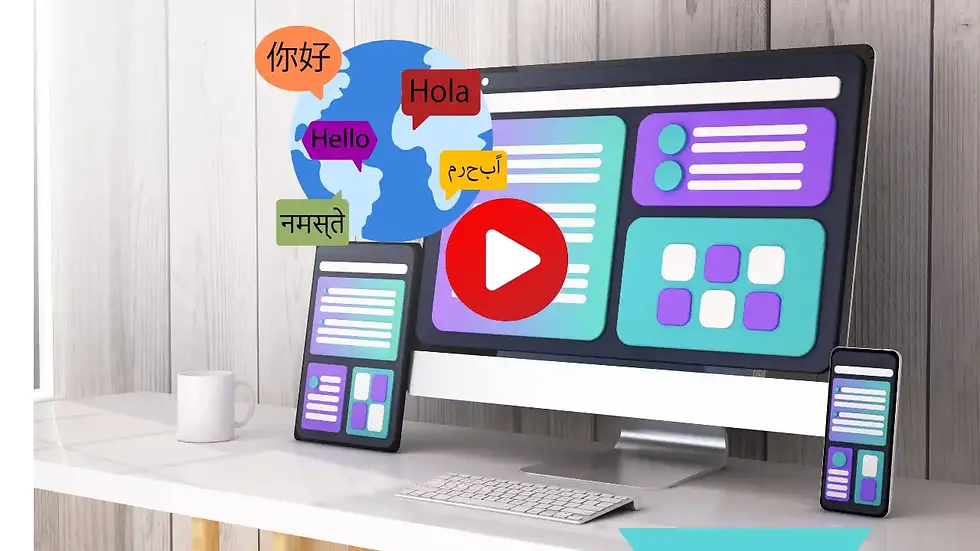
Deliver seamless, localised digital experiences to international visitors, powered by our Websling™ technology, AI translation and International SEO frameworks.

Capture your share of $4.2 trillion in untapped international markets
.png)
Convert the 76% of global shoppers

Transform global expansion from risk to revenue

Stop losing market share daily


Trusted by Over
250
Customers
See what happens when your website speaks their language
Our multilingual clients see an average 35–50% boost in international traffic and significantly longer on-page engagement once localised.

eCommerce Brand:
+47% organic traffic after multilingual rollout

B2B Tech Firm:
2.5X lead conversion increase in European markets
Your customers are global. Your website isn't.
When 76% of international visitors leave websites that aren't in their native language, you're not just losing customers; you're handing them directly to competitors who speak their language. Websling™ changes this instantly, transforming your single-language site into a multilingual customer magnet that converts in every market you enter.
.png)
Websling: Start small, scale fast
Zero tech expertise required
Launch in days, not weeks
Pay only for what you use
Support for all popular platforms
Smart features for global success
Page & content updates sync
Visitor Insight reports
Culturally adapted
SEO friendly
Serve customers in their language. Earn their loyalty


01
Discovery & Language Planning
We identify key markets, languages and SEO priorities
.png)

03
Translation & Optimisation
Human+AI translation, localisation of visuals and SEO tagging

04
Deployment & Monitoring
Go live in relevant markets in soft or full mode
05

Trusted by global growth brands
“Websling transformed our website into a multilingual hub for international customers. Our French and German leads doubled within 90 days.”
Marketing Director,
Irish eCommerce Brand


Product Teams:
Demos, onboarding, and adoption content
L&D Teams:
Multilingual training and workforce enablement
Growth Leaders:
Content systems that scale with markets
Whether you’re entering your first new market or managing multiple regions, this service adapts to your growth stage.

Frequently Asked Questions
A framework combining translation, AI, and cultural expertise.
Growth comes from cultural resonance + multilingual SEO.
Organizations ready to expand internationally.
Organizations ready to expand internationally.
Organizations ready to expand internationally.
Frequently Asked Questions
What does “Growth by Language™” mean for multilingual websites?
For multilingual websites, “Growth by Language™” means your site is designed not just to be translated, but to grow revenue and visibility in each market.
Instead of creating separate language versions as an afterthought, we align your:
Site architecture (domains, subdomains, subfolders)
Content and UX (navigation, CTAs, forms, trust elements)
Technology and SEO (hreflang, structured data, performance, analytics)
so that each localised site becomes a growth engine in its own language and region.
What is a multilingual website, and how is it different from simple translation?
A multilingual website is a strategically localised web experience that:
Serves content in multiple languages and regions
Adapts UX, wording, visuals and offers to local expectations
Is technically configured for international SEO and performance
Simple translation only changes words. A multilingual website under the Growth by Language™ framework changes how your brand is found, understood and trusted in each market.
Who should invest in a multilingual website?
You should consider a multilingual website if you:
Receive visitors from multiple countries or languages
Sell products or services across borders (eCommerce, SaaS, training, etc.)
Need to build trust and compliance in regulated markets (fintech, healthcare, professional services)
Want to grow organic traffic and conversions in specific countries (e.g. Germany, Brazil, Japan, MENA)
Our approach is designed for organisations with clear international growth ambitions, whether you’re just entering new markets or scaling existing ones.
How does Braahmam’s “Growth by Language™” approach differ from a typical website translation vendor?
Most vendors focus on getting pages translated. Braahmam focuses on making each language version perform.
We do this by:
Connecting website localisation to commercial goals (traffic, leads, sales, sign-ups)
Planning information architecture and language targeting for each market
Implementing international SEO best practices (hreflang, localised metadata, schema, internal linking)
Integrating with your CMS and workflows so updates are fast and consistent
Where others ask, “Did we translate the site?”, we ask, “Is your Spanish or German site winning in its market?”
How do you handle international SEO for multilingual websites?
We design multilingual websites with international SEO (ISEO) from the start. This includes:
Hreflang implementation to signal languages and regions to search engines
Localised keyword research for each market (not just direct translation)
Localised metadata and headings (titles, descriptions, H1s, H2s)
SEO-friendly URL structures per language
Technical performance checks (speed, mobile, Core Web Vitals) per market
Structured data (including FAQ schema where relevant) in each language
The result: search engines understand who each language version is for and local customers can discover and engage with the right content.
Can a multilingual website integrate with our existing CMS or eCommerce platform?
Yes. Our multilingual website solutions are platform-agnostic and integration-first.
We regularly work with:
CMS: WordPress, Drupal, Adobe Experience Manager, headless CMSs
eCommerce: Shopify, Magento, WooCommerce, BigCommerce
Marketing stacks: Marketing automation, CRM, analytics platforms
We use a mix of connectors, APIs and our Websling™ technology to automate the flow of content between your systems and our linguists, reducing manual handling and keeping all languages in sync.
How do you decide on the best structure: subdomain, subfolder or country domain?
We recommend a structure based on:
• Your current and target markets
• Brand and SEO strategy (global vs. strong local presence)
• Technical constraints and existing infrastructure
• Long-term scalability (how many markets and languages you plan to add)
We’ll typically assess your situation and propose a roadmap, for example starting with language subfolders (e.g. /de, /fr) and later expanding into country-specific strategies if needed.
How do you maintain quality and consistency across multiple languages and markets?
Quality is managed through a combination of:
Market-specific style guides and glossaries
Translation memories to keep terminology consistent over time
Human review and QA for high-impact pages (home, product, pricing, legal, conversion flows)
Continuous optimisation using performance data (bounce rates, time on page, funnels)
This ensures that your brand voice, messaging and UX feel native, consistent and trustworthy in every language.
Can you support right-to-left (RTL) languages and region-specific needs?
Yes. We support RTL languages (such as Arabic and Hebrew) and region-specific requirements, including:
Layout adaptations and RTL-compatible components
Local date, time, currency and number formats
Cultural adaptations in imagery, examples and messaging
Compliance or content sensitivities in specific regions
Our goal is to ensure that each localised site feels built for that audience, not just translated for them.
What is the best way to get started with a multilingual website project?
The best starting point is a multilingual website readiness assessment under our Growth by Language™ framework.
In this step, we:
Review your current website, analytics and target markets
Identify which languages and countries should come first
Evaluate your CMS and technical stack for localisation-readiness
Recommend a phased rollout plan (e.g. 1–2 priority markets, then expansion)
From there, we can define a pilot or first-wave launch that delivers measurable results before you scale to additional languages.

Let’s make your website global
Your customers are looking for you in their language. Let’s make sure they find you.