
Why International Growth Fails Before the First Sale

(And Why Translation Won’t Save You)
Most international growth efforts don’t fail because of bad translation. They fail because companies mistake ambition for readiness.

Over the last decade, I’ve watched capable, well-run medium-sized companies expand internationally with absolute confidence—only to stall before the first meaningful sale. The product works. The website is live. The localised campaigns are running.
Yet traction never follows.
When the numbers don’t add up, the blame usually falls on translation.
“Did we get the tone wrong in Germany?”
“Is the agency using the right terminology in Japan?”
In over 90% of cases, language isn’t the problem.
The real issue is this: the company entered the market based on assumptions, not evidence.
This is the core idea behind Growth by Language™—language is not a production task. It is a strategic stress test that exposes the cracks in your growth model.

The Silent Killers of International Expansion
International growth rarely fails during execution. It fails earlier—inside the boardroom—because of three common assumptions:
"We already operate in English, so the product is ready."
“We’ll localise once demand shows up.”
“Our digital experience is borderless.”
These assumptions quietly push companies into markets where they are:
Invisible
Untrusted
Or operationally unprepared
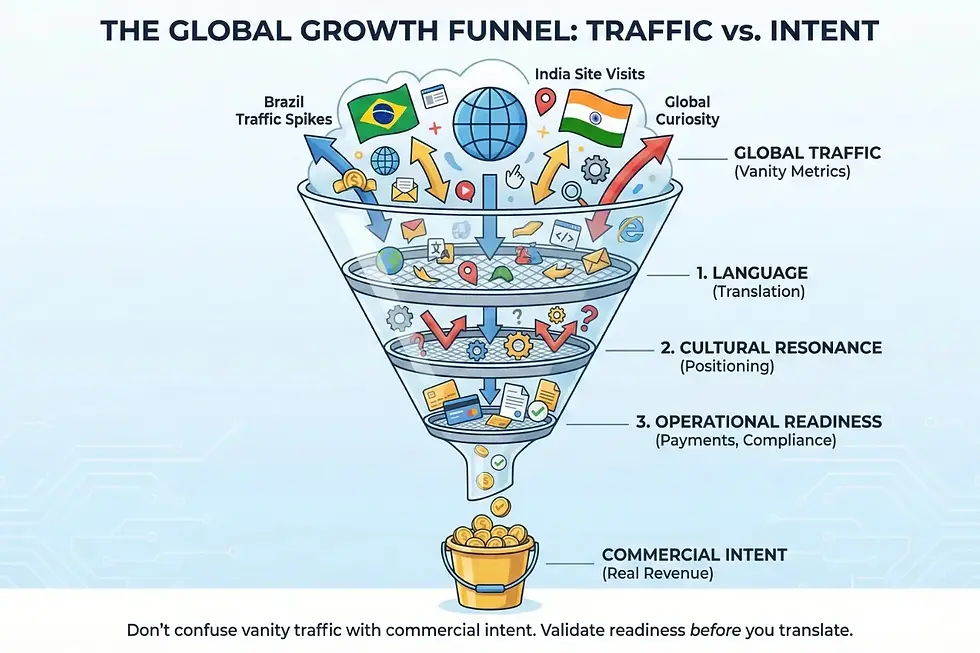
Before translating a single word, three layers of readiness must be validated.
1. Market Readiness: Intent vs. Vanity
I often see SaaS and digital businesses point to traffic from Brazil or India as proof of demand.
But traffic without intent is noise.
The trap: | You translate your UI based on traffic spikes—only to discover users can’t pay using supported methods, or have fundamentally different purchasing behaviour. |
The fix: | Validate commercial intent, not curiosity. Language should follow demand—not precede it. |
2. Message Readiness: Translation vs. Resonance
Does your value proposition survive the border crossing?
The trap: | A fintech selling “Speed” in the US may discover that the same message signals “Risk” in Germany. If you translate “Speed” perfectly, you’ve accurately delivered the wrong message. |
The fix: | Audit your positioning for cultural resonance, not linguistic accuracy. |
3. Operational Readiness: The Plumbing Check
This is the most underestimated layer—and the most dangerous.
The trap: | You launch successfully in Japan. Leads flow in. But:
|
The fix: | Ensure your back office can support your front-office ambition. |
Not sure where you stand?
Download a practical checklist to assess whether your market, messaging, and operations are aligned for international scale.
👉 Download
Language Is Your Stress Test
This is why I advise CEOs to stop treating localisation as a cost centre.
Language doesn’t create problems. It exposes them.
Weak positioning becomes obvious
Compliance gaps surface quickly
Broken processes reveal themselves
If your workflow is messy in English, it will collapse in ten languages.
If your brand voice is inconsistent at home, it will be incoherent abroad.
What Comes Next in This Series
There is no universal international playbook. Every industry breaks at a different point.
eCommerce breaks on trust (checkout, returns, post-purchase clarity)
Fintech breaks on precision (compliance, disclosure, friction)
Digital marketing teams break on intent (translated keywords vs real demand)
Where to Start—Today
Successful international growth starts by slowing down—briefly.
Before committing capital or translating your first page:
Audit your readiness—don’t guess
Identify where language has the highest commercial impact
Treat language as a growth layer, not a production task
Fixing a strategy on paper is far cheaper than fixing a failed launch in market.
Start with an International Digital Audit
Our audit identifies where language, content, technology, and operations are blocking growth—so you know exactly what to fix, and what to leave untouched.


Comments