
Why "We'll Localise Later" Is the Most Expensive Decision in International Growth

Why "We'll Localise Later" Is the Most Expensive Decision in International Growth

The conversation happens in most fintech companies at some point. A new market is approved. The team discusses localisation, agrees it is important, and moves it to the next phase.
The product launches in English first. Once there is traction, the language investment will follow. It sounds like sensible prioritisation. In practice, it is one of the more costly decisions a scaling company can make.
The Clock Starts Before You Do
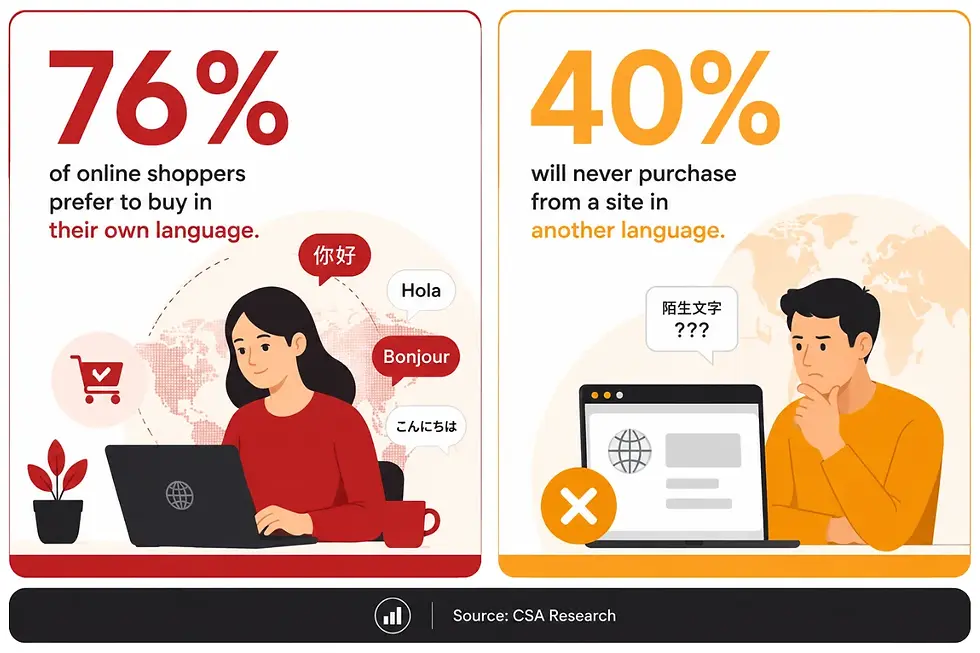
Deferring localisation does not pause the market while you get ready. In the time between an English-only launch and a properly localised one, search visibility in the target market is growing - but not for you. A fintech competitor that launched local-language content six months earlier is already accumulating organic authority, trust signals, and customer relationships.
A delayed launch soon becomes a compounding gap between you and your competitors.

The paid search problem is equally concrete. Many companies entering new markets do not localise their Google Ads campaigns. Instead, they simply reuse the same English creative, the same keyword list, the same landing pages, now targeting a French or Brazilian or German audience.
The result? Conversion rates underperform. The team concludes that the market is not ready, or that demand is lower than expected, and scales back investment.
What they are actually measuring is the performance of English-language content in a non-English market - a reliable way to generate misleading data and waste budget simultaneously.
What Rework Actually Costs
When localisation eventually commences, it’s rarely a clean fit with a product that was originally built for one language.
Content written for a single market carries assumptions about tone, regulatory framing, and customer trust signals that do not transfer. User interfaces designed without multilingual text expansion break. Compliance documentation built for one jurisdiction needs to be rebuilt, not translated, for the next.
The cost of localisation at launch is a fraction of the cost of localisation as a retrofit.
For fintech companies in particular, the stakes are higher than in most sectors. Regulatory disclosures, onboarding flows, and payment interfaces all carry legal and trust implications that vary by market.
A financial product that reads as foreign - in either language, tone or structure - does not simply convert less well. It will struggle to establish the baseline credibility that financial services require.
Revolut's early European expansion succeeded in part because localised onboarding and in-app language were treated as launch requirements, not post-launch enhancements.
Starting Small Is Not the Same as Starting Late
The most common objection to early localisation is resource: the budget, the time, and the internal bandwidth required to do it properly.
It is a reasonable concern, and it points to a real problem with how localisation is traditionally scoped and priced - as a large, complex programme that demands full commitment before it delivers any return.
The modern alternative is iterative by nature. Rather than localising everything at once, a focused first investment gives you real market signal without full programme overhead.
Start with your marketing homepage, your core onboarding flow, your highest-traffic acquisition content in a single priority language. Measure and validate your product-market fit before scaling further.

DocuSign built one of the most successful international expansion strategies in SaaS not by localising everything simultaneously, but by making it easy to start small and expand as usage grew. The same principle applies to language investment.
For a fintech company eyeing its first non-English market, the question is not whether to localise - the data on that is settled.
The question is how to start in a way that generates signal, builds momentum, and creates a foundation worth expanding. Starting small and early produces a result that is genuinely scalable. Starting late produces a retrofit.
Ready to identify your highest-value localisation starting point?
Explore Braahmam's International Readiness Audit



Comments